


.png)
- 24/09/2026
- Dr. Kunaal Shinde
- 0 Comments
- Blog
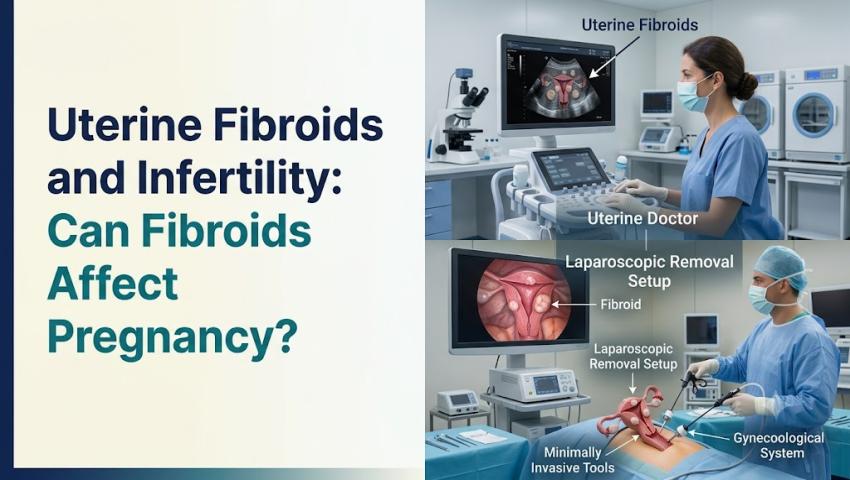
Uterine Fibroids and Infertility: Can Fibroids Affect Pregnancy?
The scan report says “fibroid uterus”. Under it, a measurement in millimetres. And somewhere between reading that line and your next appointment, the question has already formed — does this mean I cannot have a baby?
For most women, the answer is no.
Fibroids are extremely common, and the majority of women who have them conceive without any difficulty at all. But the link between fibroids and infertility is genuinely real in a smaller group — and it depends almost entirely on one factor that most reports do not explain clearly. Not the size. The location.
Most Fibroids Do Not Cause Infertility:
Fibroids are non-cancerous growths of the muscular wall of the uterus. They are found in a large proportion of women of reproductive age, and a great many of those women never know they have one until a routine scan picks it up.
Fibroids are graded by where they sit, not by how alarming the number beside them looks. A 6 cm fibroid growing outwards from the uterus may have no effect on fertility whatsoever, while a 1 cm fibroid growing into the cavity can matter a great deal.
So a fibroid on a report is not a fertility diagnosis. It is a finding that needs to be placed correctly before anyone can say what it means for you.
Where the Fibroid Sits Matters More Than Its Size?
- Submucosal Fibroids: These grow inward and press into the cavity where an embryo needs to implant. A submucosal fibroid is the type most consistently linked with difficulty conceiving and with early pregnancy loss, and it is the type most likely to be worth removing before you try. Even a small one can matter, because the problem is position rather than bulk.
- Intramural Fibroids: These sit within the wall itself. The key question is whether the fibroid distorts the shape of the cavity. If it does, it behaves rather like a submucosal fibroid. If it does not, and it is small, it can often be safely left alone.
- Subserosal Fibroids: These grow outwards, away from the cavity. They can become large and cause pressure symptoms, but they rarely interfere with conception. Removing one purely because it exists is usually unnecessary.
How a Fibroid Can Stop You Getting Pregnant?
When a fibroid does cause a problem, it works through one of these routes:
- Blocking implantation by occupying or distorting the cavity lining
- Reducing blood flow to the endometrium, so the lining is less receptive
- Obstructing the fallopian tube openings, preventing sperm and egg from meeting
- Changing the shape of the cervix, making sperm passage harder
- Causing heavy bleeding and anaemia, which affects overall reproductive health
Notice that all of these are mechanical. This is why the link between fibroids and infertility is so location-dependent, and why two women with identically sized fibroids can have completely different outcomes.
Fibroids During Pregnancy: What Can Go Wrong?
Most pregnancies with fibroids proceed normally. Where complications occur, they include:
- Miscarriage — the honest answer to can fibroids cause miscarriage is yes, but mainly with cavity-distorting fibroids
- Red degeneration — a fibroid outgrowing its blood supply, causing significant pain in the second trimester
- Preterm labour, particularly with large or multiple fibroids
- Malpresentation — a fibroid limiting space so the baby lies breech or transverse
- Higher chance of caesarean delivery
- Heavier bleeding after delivery
None of these is inevitable. They are reasons for closer monitoring, not reasons to avoid pregnancy.
Signs You May Have a Fibroid:
Many fibroids are silent. When fibroid symptoms do appear, they include:
- Heavy or prolonged periods, sometimes with clots
- Periods that leave you exhausted, or a diagnosis of anaemia
- Pelvic pressure, or a feeling of fullness in the lower abdomen
- Needing to pass urine frequently
- Pain during intercourse
- Lower back pain that does not settle
- Difficulty conceiving, or repeated early miscarriage
Tests That Confirm It:
A pelvic ultrasound usually finds a fibroid and gives its size. What it does not always establish is whether the cavity is affected — and that is the answer that changes the plan.
Depending on the picture, Dr. Kunaal K. Shinde may add a saline infusion sonography or an MRI to map the fibroid precisely. Where the cavity needs to be seen directly, a diagnostic hystero-laparoscopy both confirms the position and allows treatment in the same sitting.
When Surgery Is Needed Before Trying — and When It Is Not?
Removing every fibroid is not good medicine. Surgery carries its own recovery, and an unnecessary operation delays the very thing you are trying to achieve.
Removal is usually advised when:
- The fibroid is submucosal or distorts the cavity
- You have had repeated miscarriages with no other explanation
- Symptoms are severe — heavy bleeding, anaemia, significant pain
- A large fibroid is blocking the tubes or obstructing access
- IVF is planned and the cavity needs to be optimal first
Removal can usually be avoided when:
- The fibroid is subserosal and causing no symptoms
- It is small, intramural, and the cavity is normal
- You are close to menopause and symptoms are manageable
- You have been trying for only a short time with no other findings
If you have been trying for under a year with a small, well-positioned fibroid, the fibroid may not be the reason at all. A full fertility assessment comes first.
Laparoscopic Myomectomy: What It Involves?
A myomectomy removes the fibroid and preserves the uterus — which is the whole point when you intend to conceive.
Done laparoscopically, it uses a few small incisions and a camera rather than an open cut. The fibroid is removed and the uterine wall is repaired carefully, since that repair determines how the uterus will hold a future pregnancy. Submucosal fibroids can often be removed hysteroscopically, through the cervix, with no external incision at all.
Most women go home within a day or two and return to normal activity in two to three weeks, compared with six or more after open surgery. Dr. Kunaal K. Shinde performs laparoscopic myomectomy in Pune at Love Your Belly Clinic, Baner and at hospitals across Baner, Aundh and Pimple Saudagar.
Most surgeons advise waiting three to six months after fibroid removal surgery before trying to conceive, depending on how deep the repair went.
Been told you have a fibroid and want a straight answer?
Whether a fibroid is affecting your fertility depends on exactly where it sits — a question worth settling properly before you spend another year wondering. Dr. Kunaal K. Shinde offers laparoscopic assessment and fertility-preserving fibroid surgery at Love Your Belly Clinic, Baner and Cloudnine Hospital, Pimple Saudagar.
Frequently Asked Questions:
Yes. A submucosal fibroid can affect implantation without causing heavy bleeding. Position matters more than symptoms, which is why cavity assessment is part of any fertility workup.
Some do, particularly in the first trimester, and some shrink. Dr. Kunaal K. Shinde monitors fibroid size through pregnancy where it is large or centrally placed.
New fibroids can develop later, though the one removed does not return. Careful surgical technique and follow-up reduce the chance of needing repeat surgery.
Usually not. Dr. Kunaal K. Shinde recommends removal only where the fibroid is affecting fertility, causing significant symptoms, or is positioned to complicate a pregnancy.