


.png)
- 07/10/2026
- Dr. Kunaal Shinde
- 0 Comments
- Blog
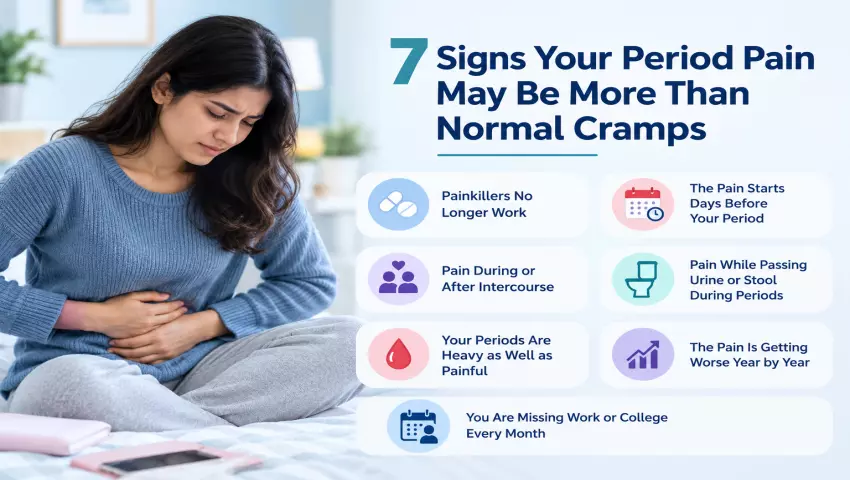
7 Signs Your Period Pain May Be More Than Normal Cramps
“Everyone gets period pain.”
You have probably heard it from a friend, an aunt, maybe even a doctor. And it is true — most women do. But it is also the single reason conditions like endometriosis take an average of seven to ten years to diagnose. Women are told the pain is normal, so they stop mentioning it.
Some period pain genuinely is normal. Some is a symptom. The difference is not how much you can tolerate — it is the pattern. Here are seven signs worth taking to a gynaecologist rather than another painkiller.
What Normal Period Pain Feels Like?
Normal cramps are dull, low in the abdomen, and start with the bleeding or a few hours before it. They ease within the first day or two, respond to a painkiller and a hot water bag, and let you go about your day.
That is ordinary period pain. Anything that keeps breaking that pattern deserves a closer look.
Sign 1: Painkillers No Longer Work
One tablet used to be enough. Now you are taking them every four hours, stacking two kinds, and still lying down.
Escalating medication is the clearest early signal. Pain that outgrows an ordinary painkiller usually has a physical cause behind it — most often endometriosis, adenomyosis or fibroids.
Sign 2: The Pain Starts Days Before Your Period
Normal cramps arrive with the bleeding. If yours reliably begin two, three or five days earlier — and continue after the bleeding stops — that longer window is a recognised pattern in endometriosis symptoms. Pain that occupies half the month is not a bad period. It is a monthly condition.
Sign 3: Pain During or After Intercourse
Deep pain during intercourse, or an ache that lingers for hours afterwards, is one of the most commonly ignored endometriosis symptoms — usually because it feels too private to raise.
It matters clinically. Tell your gynaecologist. It genuinely changes what they examine and what they look for on a scan.
Sign 4: Pain While Passing Urine or Stool During Periods
Pain that appears only around your period, while passing urine or opening your bowels, suggests tissue involvement beyond the uterus.
The cyclical timing is the clue. Bowel or bladder pain every day points elsewhere; pain that arrives with your period and disappears afterwards points to endometriosis affecting nearby structures.
Sign 5: Your Periods Are Heavy as Well as Painful
Pain and volume together carry more weight than either alone. Be concerned if you are changing a pad every hour or two, passing large clots, bleeding beyond seven days, or feeling tired and breathless from low haemoglobin.
Heavy periods with severe pain most often point to fibroids or adenomyosis — both readily identified, and both treatable.
Sign 6: The Pain Is Getting Worse Year by Year
Normal cramps stay roughly the same, or improve with age and after childbirth.
Pain that has steadily worsened over three, five or ten years follows the pattern of a progressive condition. Endometriosis and adenomyosis both behave this way, which is exactly why waiting to see if it settles rarely works in your favour.
Sign 7: You Are Missing Work or College Every Month
This is the practical test, and the one to trust.
If you plan leave around your cycle, cancel on people, or lie down through the first day every month, the pain is already interfering with your life. No number on a pain scale is needed. Disruption on its own is reason enough for an assessment.
What These Signs Usually Point To?
Tests Your Gynaecologist Will Do:
Assessment usually begins with your history — when the pain starts, how long it lasts, what it stops you doing — followed by an examination and a pelvic ultrasound.
Where the scan is normal but the symptoms are not, a diagnostic laparoscopy lets Dr. Kunaal K. Shinde see the pelvis directly. Early endometriosis frequently does not appear on any scan, which is precisely why so many women are told nothing is wrong.
How These Conditions Are Treated?
Treatment is matched to the cause, your symptoms and whether you want to conceive.
Medical options — hormonal tablets, a hormonal IUD, or a short course to suppress the cycle — control symptoms well for many women. Where medicine is not enough, or fertility is affected, laparoscopy for endometriosis removes the deposits through a few small incisions, with most women home within a day.
The important point is that these are all treatable. Severe pain every month is not something you are supposed to manage on your own.
Tired of planning your month around your period?
If any of these seven signs sound familiar, it is worth one appointment to find out why. Dr. Kunaal K. Shinde offers laparoscopic diagnosis and treatment for endometriosis, adenomyosis and fibroids at Love Your Belly Clinic, Baner and Cloudnine Hospital, Pimple Saudagar.
Frequently Asked Questions:
Normal cramps last a day or two, respond to a painkiller and do not stop you working. Pain that escalates, starts days early, or makes you miss work needs assessment.
Not always. Early endometriosis often does not show on a scan. Dr. Kunaal K. Shinde may recommend laparoscopy where symptoms are strong but imaging is normal.
Sometimes, but not reliably, and pregnancy is not a treatment. Conditions like adenomyosis frequently return afterwards.
Severe period pain is not normal at any age. Dr. Kunaal K. Shinde sees endometriosis in patients in their late teens, and early diagnosis protects future fertility.