


.png)
- 28/07/2026
- Dr. Kunaal Shinde
- 0 Comments
- Blog
Dermoid Cyst vs Simple Ovarian Cyst: What’s the Real Difference?
Your ultrasound report says “ovarian cyst,” and now you’re stuck wondering what that actually means. Not every cyst behaves the same way, and the two types people confuse most, a simple cyst and a dermoid cyst, are quite different from each other. Dr. Kunaal Shinde, a gynaec laparoscopic surgeon at Love Your Belly Clinic in Baner, Pune, sees both types every week, and the distinction matters more than most patients realize.
The Quick Answer:
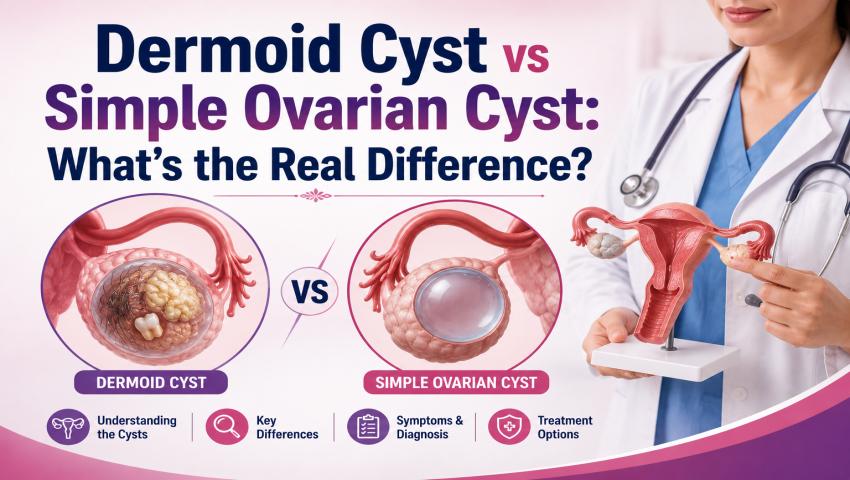
A simple ovarian cyst is a sac of clear fluid. It usually forms during a normal menstrual cycle and disappears on its own within a few weeks. A dermoid cyst is different. It’s a mix of tissue types, sometimes fat, hair, or even tiny teeth, and it has been there since birth. It won’t shrink on its own, and it almost always needs surgical removal. If your report mentions “complex” or “mixed echogenic” findings, you’re likely looking at a dermoid cyst, not a simple one.
What Exactly Is an Ovarian Cyst?
An ovarian cyst is a fluid-filled sac that forms on or inside the ovary. Most women develop at least one during their lifetime, often without ever knowing it.
Doctors split cysts into two broad groups. Functional cysts form as part of a normal ovulation cycle and rarely cause trouble. Pathological cysts grow from abnormal cell activity, and this group includes dermoid cysts, endometriomas (often treated through laparoscopic chocolate cyst removal surgery), and cystadenomas.
A simple cyst almost always falls into the functional group. A dermoid cyst is always pathological.
Side by Side: Simple Cyst vs Dermoid Cyst
Numbers make this easier to grasp than paragraphs of description. Here’s how the two compare across the details that actually matter for diagnosis and treatment.
What Makes a Dermoid Cyst So Different?
A dermoid cyst starts forming very early in life, from the same germ cells that eventually go on to form eggs. That’s why it can contain tissue you wouldn’t expect inside an ovary: skin, hair follicles, fat, and occasionally fully formed teeth.
This isn’t a birth defect, and it says nothing unusual about the woman herself. It’s simply how these particular cells develop when they aren’t involved in forming an egg.
Because a dermoid cyst is made of solid, dense material rather than clear fluid, it doesn’t drain or shrink the way a simple cyst can. Once it’s there, it tends to stay, and it often grows slowly over years.
Why It's Called a “Mature Teratoma”?
Doctors also call a dermoid cyst a mature cystic teratoma. “Teratoma” comes from the Greek word for monster, a nod to how unusual the mixed tissue looks under a microscope. “Mature” simply means the cells are fully developed and non-cancerous, unlike an immature teratoma, which is rare and needs different treatment.
Symptoms: Which One Might You Have?
Many small cysts, of either type, cause no symptoms at all and turn up only on a routine scan. When symptoms do appear, they tend to overlap: a dull pelvic ache, bloating, or a feeling of pressure low in the abdomen.
A simple cyst tends to cause mild, come-and-go discomfort tied to your cycle. A dermoid cyst is more likely to cause a constant, low ache as it grows, simply because of its size and weight.
Red Flags: When It's Torsion or Rupture, Not “Just a Cyst”?
Sudden, sharp pain on one side, especially with nausea or vomiting, is not something to wait out. It can mean the cyst has caused the ovary to twist on itself, a condition called ovarian torsion. Dermoid cysts are more prone to this because of their weight and solid contents.
A ruptured cyst can also cause sudden pain, sometimes with light bleeding. Both situations need same-day medical attention, not a wait-and-watch approach.
How Your Gynaecologist Tells Them Apart?
An ultrasound is usually the first and most useful test. A simple cyst shows up as a plain, dark, fluid-filled circle. A dermoid cyst looks messier on the scan, with mixed bright and dark areas because of its varied contents.
Dr. Kunaal Shinde often points out that the ultrasound picture alone is usually enough to tell the two apart with good confidence. In occasional unclear cases, a blood test called CA-125 is added, mainly to rule out other causes rather than to diagnose the cyst type itself.
If you’re exploring ovarian cyst treatment options, this diagnosis stage is where your doctor decides whether to simply monitor the cyst or plan for its removal.
Treatment: Watch and Wait vs Surgery
A simple cyst rarely needs treatment. Most gynaecologists, including Dr. Kunaal Shinde, recommend a repeat ultrasound after one to three menstrual cycles. If the cyst has shrunk or disappeared, which is common, no further action is needed.
A dermoid cyst is a different story. Because it doesn’t resolve on its own and carries a real risk of torsion as it grows, surgical removal is usually advised even without symptoms, particularly once it crosses a certain size.
The good news is that removal doesn’t have to mean major surgery.
Laparoscopic Cyst Removal: What to Expect?
Most dermoid cysts, and any simple cyst that needs removing, are treated through laparoscopic surgery. A gynaec laparoscopic surgeon makes a few small incisions, removes the cyst while preserving healthy ovarian tissue, and the whole procedure typically takes under an hour.
Recovery is fast compared to open surgery. Most women go home the same day or the next morning, and return to normal activity within a week or two.
Could Either One Turn Into Cancer?
This is the question most people actually want answered, so it’s worth being direct about the numbers. A simple cyst carries an extremely low cancer risk, close to none, especially in women who are still menstruating.
A dermoid cyst carries a slightly higher but still small risk, roughly one to two percent, of containing cancerous elements. This risk doesn’t really change whether the cyst is small or has been present for years, which is exactly why surgical removal is usually recommended rather than indefinite monitoring.
For cysts that look unusual on scan, or come with a family history of ovarian cancer, your doctor may also discuss ovarian cancer treatment pathways as part of a fuller workup.
When to See a Gynaecologist in Baner, Pune?
If you’ve been told you have an ovarian cyst and you’re not sure which type, or whether it needs treatment, don’t sit with the uncertainty. A quick ultrasound and consultation usually gives a clear answer within a single visit.
Dr. Kunaal Shinde, an advanced robotic and laparoscopic gynaec surgeon based in Baner, Pune, sees patients with both simple and dermoid cysts regularly, whether for a first opinion or before planned surgery. If you’re in Baner or anywhere else in Pune, getting it checked early is a lot simpler than living with the question mark.
Quick FAQs:
No. Unlike a simple fluid cyst, a dermoid cyst is made of solid tissue and won’t shrink or resolve without surgical removal.
Small ones often cause no pain at all. Pain usually shows up once the cyst grows large enough to press on nearby structures, or if it causes torsion.
There’s no single cutoff, but most gynaecologists consider surgery once a cyst crosses 5 to 6 cm, or earlier if it’s clearly a dermoid cyst rather than a simple one.
Yes, though it’s uncommon. Some women are found to have a simple cyst on one ovary and a dermoid cyst on the other during the same scan.
If your last scan mentioned a cyst and you’re unsure what kind, book a consultation with Dr. Shinde at Love Your Belly Clinic and get a clear answer instead of a guess.